
Business systems
What a drinks fridge can teach a midsize company about building its own software
Rivella had a form, a Teams channel and a custom SAP tool. The same request still had to be typed twice.
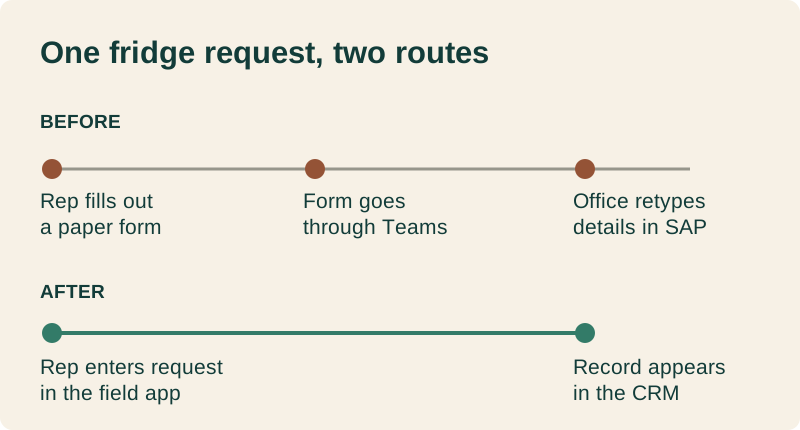
A restaurant needs a drinks fridge. For the field rep who visits the restaurant, this is an ordinary request. At Swiss beverage maker Rivella, it used to set several people to work. Someone filled out a paper form. It went to the back office through Microsoft Teams. Someone else keyed the details into a tool built for tracking fridges in SAP. Every system in that sequence could be working perfectly and the office would still have a typing job. ORBIS’s account of the Rivella rollout
Rivella AG, with about 230 employees according to implementation partner ORBIS, had a good reason to build something specific. A sales rep placing a new fridge and a rep reporting a fault both need the customer record. The office needs to know which piece of equipment is where. With Rivella’s input, ORBIS built a Power App that puts requests, fault reports and signatures into the customer system. Reps tried it in the field and asked for changes. Rivella case and images
The software was ready by Christmas 2025. Rivella waited until its March 2026 field sales meeting to introduce it to everyone. I like that detail because it names an expense most project estimates leave out: somebody has to show the people visiting restaurants how tomorrow morning will work. ORBIS says retyping the forms ended after rollout. Its case gives no measured dollar return. The disappeared typing job is a perfectly good result to report. Implementation and rollout
Who can change the app next month?
For a company weighing an internal build, it helps to separate three jobs: who knows the rule, who can turn it into working software, and who will maintain it. Rivella and ORBIS shared the work. A larger manufacturer offers a different arrangement. At Vanderlande, an analytics engineer and an ICT adoption specialist met weekly to replace a fragile routine that depended on input files staying in the expected format. Using Microsoft Power Apps and Dataverse, they put order information from three factories into a common view. Microsoft’s customer account describes how the two employees learned and built the application together. Vanderlande’s internal build
Sometimes the part that calls for AI is the front door. At Growth xPartners, a Japanese technology group of roughly 300 people, an employee could need help filing a change of address or commuting expenses. Some needed that help in another language. Its HR staff worked with engineers and an implementation partner to handle intake through an agent available in Slack. Employees could explain what they needed. HR kept final decisions and confirmations. Here, ordinary workflow software could store the record, while a conversational interface helped different people find their way into the right procedure. IBM’s Growth xPartners case
A question for this month’s budget meeting
Microsoft says access to apps made in its Power Apps Vibe experience runs through November 30, 2026. Its manual migration instructions call for rebuilding from downloaded source and checking the new app’s connections. Records saved in Dataverse or SharePoint stay in place. Draft tables need attention. That notice concerns a particular app-building experience. Rivella’s rollout is a separate case. Read together, they give an operations manager a practical question: if your builder changed tomorrow, who on staff could tell whether the replacement still worked? Microsoft’s migration guide
Before funding a custom app, pull one awkward request from last month and put it on the table. For a fridge business, imagine a restaurant changing hands while a replacement is on order. Have the field rep show which location stays the same, the office explain who can sign, and the person maintaining the app show what happens to the open request. Use a test record. Repeat the exercise when the app changes hands.
A midsize company can buy the platform and hire help with the build. The valuable thing to own in-house is the ability to recognize the right answer when a real restaurant needs its fridge.